
NELSON MANDELA — THE DAY HE WALKED DOWN THE MALL
London, 10 July 1996
The day being late for an assignment turned out to be the best thing that could have happened.
Over the years, working as a London press photographer, I covered countless assignments involving royalty, politicians, film stars and visiting world leaders. Some went exactly according to plan. Others were memorable for entirely different reasons.
My encounter with Nelson Mandela in July 1996 certainly falls into the latter category.
Mandela was in London on an official visit and was staying at Buckingham Palace. One of his engagements was a tree-planting ceremony in St James's Park, not far from Trafalgar Square. As I understood it, he was expected to be driven there from the Palace.
It should have been a fairly straightforward assignment. Get there early, find a decent position amongst the other photographers, photograph Mandela planting the tree, and get the film back to the agency.
Unfortunately, things didn't quite work out that way.
A race against time
London traffic had conspired against me, and I was running seriously late. By the time I found somewhere to park near Hyde Park Corner, I was convinced I had little chance of making the assignment.
There was nothing for it but to run.
Carrying my camera equipment, a small backpack and a lightweight photographer's stepladder, I set off towards Buckingham Palace and The Mall. It was a considerable distance, particularly with all that equipment.
By the time I approached the Palace, I was sweating, panting and wondering whether I'd wasted my morning.
Then I noticed something rather unexpected.
About 50 yards ahead of me was a sizeable group of people, including police officers, security personnel, officials and members of the public. They were just moving away from the Queen Victoria Memorial outside Buckingham Palace, affectionately known to photographers as the Wedding Cake.
And right in the middle of them was Nelson Mandela.
Instead of being whisked away in the expected limousine, Mandela had decided to walk.
Quite what prompted the change of plan, I couldn't say. But after spending 27 years in prison, perhaps the prospect of stretching his legs along one of London's most famous streets had a certain appeal.
Whatever his reason, the decision appeared to have caught some of those responsible for his security rather by surprise.
It had also, quite unexpectedly, rescued my assignment.
An unexpected encounter
I quickly caught up with the procession, changed to a wider-angle lens and prepared my flash.
There was no time to stand back and admire the occasion. I needed to get ahead of the group, turn around and photograph Mandela as he approached.
That was easier said than done.
There were police officers, security personnel, officials and other people moving in every direction. Radios were being used, instructions were being exchanged, and everyone seemed intent on keeping the procession moving.
I managed to get ahead and position myself for a photograph, but as I tried to get close enough, police officers moved to stop me.
Then something happened that I have never forgotten.
Mandela noticed what was going on.
“OK, OK, he's OK,” he said, indicating to the police officers that I should be allowed to continue photographing him.
I can still remember hearing his distinctive, rather high-pitched South African voice, so familiar from countless television and radio broadcasts. But this time it wasn't coming from a television or radio. Nelson Mandela was standing just a few feet away, speaking on my behalf.
For a London press photographer desperately trying to rescue an assignment, it was an extraordinary moment.
I didn't need telling twice.
With my wide-angle lens and flash ready, I managed to expose a few frames as Mandela and the procession moved past me.
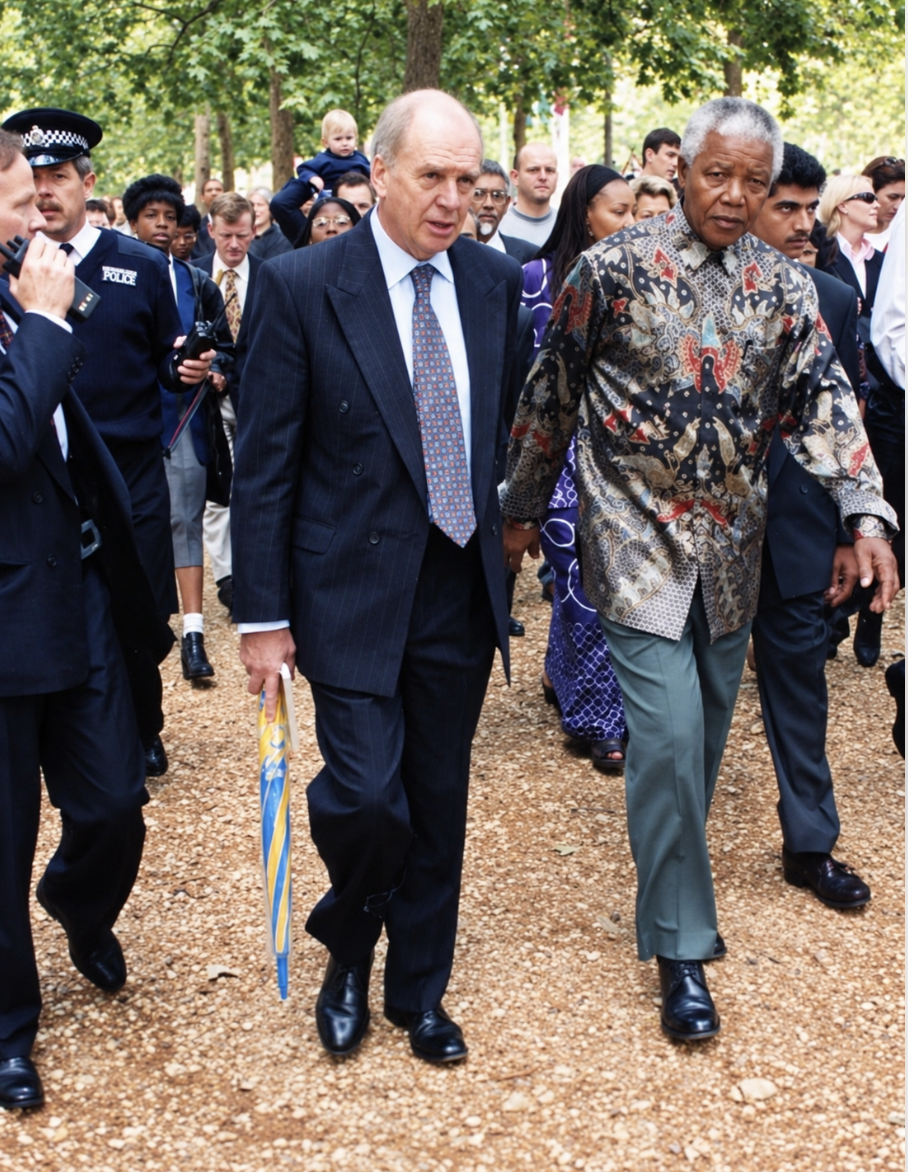
I remember that he wasn't smiling. He had a serious, determined expression as he walked alongside a British official, surrounded by police and security personnel, some speaking into their radios.
There was very little time to compose anything elaborate. The whole scene was moving, and within moments the procession had passed.
But I had my pictures.
The ceremony I nearly missed
I followed the procession to the tree-planting ceremony in St James's Park, where a large number of photographers had already gathered.
By the time I arrived, the best positions were taken.
I managed to gain access and photograph the ceremony, but my vantage point was poor, and the resulting pictures were nothing special.
The irony wasn't lost on me.
I'd spent the morning desperately trying to reach the official event, only to discover that my most interesting photographs had been taken on the way there.
At the time, it was another assignment in a busy working week. There would be more jobs to cover, more films to process and more photographs to get onto picture desks.
But the encounter stayed with me.
One surviving photograph
Thirty years later, I have just one surviving photograph from that morning.
It shows Mandela walking alongside a suited official, surrounded by police, security personnel and members of the public. His expression is serious, just as I remember it.
Looking at it today brings back the frantic run, the weight of the camera bag, the rush to change lenses and the difficulty of finding a clear position amongst the crowd.
Above all, it reminds me of those few words, spoken in that unmistakable South African voice:
“OK, OK, he's OK.”
During my career, I photographed many well-known people, often in circumstances where security and press officers made the photographer's job considerably more difficult.
But I cannot recall another occasion quite like this one, when the person I was trying to photograph personally intervened to help me get the picture.
And to think that, had I arrived on time, I might have been standing with all the other photographers waiting for a limousine.
Sometimes, in press photography, being in the wrong place at the wrong time turns out to be exactly the opposite.
Stephen Butler
Photograph: Nelson Mandela walking from Buckingham Palace towards St James's Park, London, 10 July 1996. © Stephen Butler.
On that morning Mandela planted a London plane tree in St James's Park, subsequently known as the Mandela Tree.